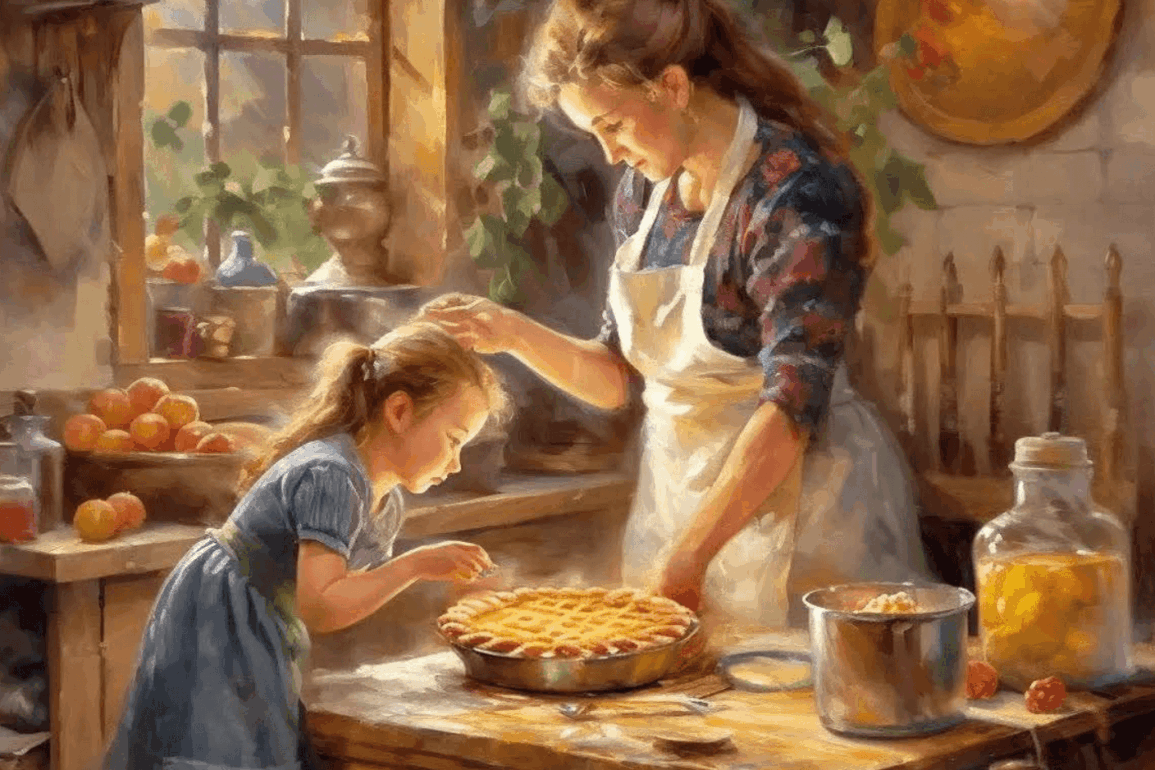
Homemaking — what comes to mind when you hear that word?
For many, it conjures the familiar image of “old-fashioned living”: a woman in a dress and apron, windows open, a pie cooling on the countertop. It’s a nostalgic picture, but also one that modern culture has learned to scoff at.
For decades, the idea of a woman being “just at home” has been quietly dismissed. Few say it openly, yet the message lingers beneath the surface: I always felt there had to be more than homemaking.
I’ve heard this from progressive feminists, from evangelical Christians, and from women across every background — a shared belief that building a home simply can’t be enough.
But when we step back, look at history, and examine the outcomes of the past seventy years, something surprising comes into focus:
homemaking may be one of the most stabilizing forces a society can have.
Homemaking may be one of the most stabilizing forces a society can have.
A Look Back
In the 1950s, most women were at home. Babies stayed with their mothers through their early years. Children came home from school to a warm house, someone waiting for them, a meal being prepared. Women used their skills — cooking, hospitality, budgeting, stewardship — to create homes that actually functioned as the emotional center of family life.
This wasn’t “small” work. It was formative work.
As homemaking slowly faded from culture and two working parents became the norm, society shifted. Not all changes were bad — many opened doors for women — but we cannot ignore one truth:
When the home weakens, the ripple effects reach far beyond the front door.
When There’s No One Home
Children returning to empty homes after school experience a very different tone to their day. A rushed or inconsistent dinner weakens the family rhythm. Hours spent outside the home — in after-school care, in basements, or in front of screens — shift the center of influence. Instead of being shaped by the home, children become shaped by their peers, the internet, and the wider world.
Studies consistently show that unsupervised after-school hours are when the majority of youth risk behaviors occur. Not because parents are neglectful — but because no home can fill its role if no one is in it.
And when children never participate in homemaking themselves — cooking, chores, setting the table, tending to the environment around them — they miss out on something deeply human:
a sense of purpose, contribution, and responsibility.
Homemaking Isn’t Small — It’s Structural
The decline of homemaking hasn’t only affected families; it has reshaped the culture at large.
Increased crime.
Decreased community cohesion.
A loss of neighborhood ties.
A weakening of family meals, traditions, and shared rhythms.
A sense of rootlessness — both for children and adults.
We often talk about “fixing society” with policies, programs, and new systems. But perhaps the healing begins somewhere quieter: with the home.

With women who choose to build atmospheres of peace and order.
With families who prioritize presence over pressure.
With mothers who are physically and emotionally available.
With children who grow up anchored, not drifting.
A Calling Worth Championing
Homemaking is not outdated. It is not inferior. It is not “less than.”
It is a powerful, culture-shaping vocation — one that forms the next generation in ways schools and institutions simply cannot replicate.
Women don’t need to reject ambition, intelligence, or creativity to be homemakers. Homemaking requires all of those things: problem-solving, management, discipline, artistry, and vision.
If anything, homemaking may be exactly what our world needs more of.
More warmth.
More structure.
More presence.
More homes that feel like safe harbors.
Homemaking might just save our nation — not through politics, but through mothers and women choosing to build something beautiful and whole again.